

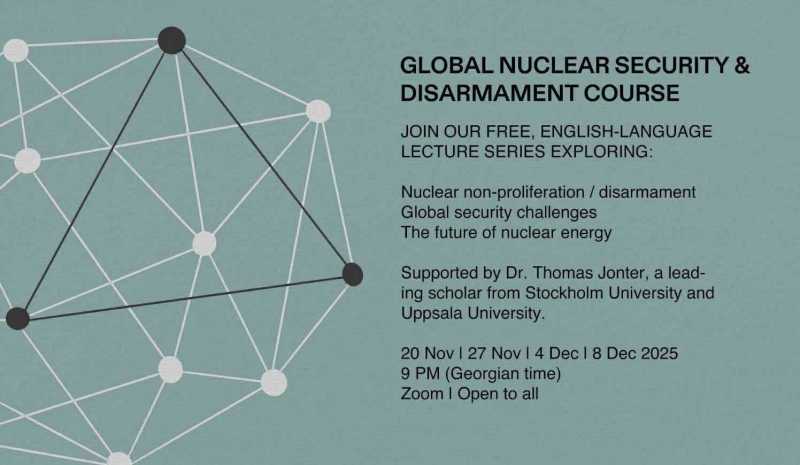
On 20 November, 27 November, 4 December and 8 December 2025, the Civil Council on Defense and Security (CCDS) organized a four-lecture online course on global nuclear security and disarmament, which brought together international and Georgian participants including students, policymakers, journalists, and other interested audience members to discuss the control and elimination of the world’s most destructive weapons and the future of nuclear energy. The free series was delivered in English and was supported by CCDS’s colleague and long-time friend of Georgia, Dr. Thomas Jonter.
Across the sessions, participants explored the foundations and evolution of the global nuclear non-proliferation architecture, with particular attention to the Nuclear Non-Proliferation Treaty (NPT). In the first lecture, the discussion focused on how the NPT regime emerged and why it became the central framework for preventing the spread of nuclear weapons. The webinar reviewed the treaty’s core logic; limiting proliferation while linking non-nuclear states’ obligations to broader commitments on disarmament and access to peaceful nuclear technology, highlighting why the NPT remains the “cornerstone” of the international system in this area.
On 27 November 2025, the second lecture examined the history of nuclear disarmament from the Cold War’s peak to more recent decades. It summarized major milestones and highlighted why eliminating nuclear arsenals remained difficult despite repeated political commitments and arms-control agreements.
On 4 December 2025, the third lecture assessed the nuclear non-proliferation regime today, including the role of institutions such as the IAEA and the challenges created by compliance disputes. The discussion also addressed criticism of the NPT’s asymmetrical structure and how this affected trust and cooperation among states.
On 8 December 2025, the final lecture explored the future of nuclear power and the meaning of the NPT’s “inalienable right” to peaceful nuclear energy. It discussed the renewed interest in nuclear energy as a low-carbon option while emphasizing the technical and institutional safeguards needed to prevent diversion toward weapon development.
Overall, the series strengthened public understanding of how treaties, institutions and political incentives shape nuclear order, linking arms control and disarmament debates to the real-world governance challenges of expanding peaceful nuclear energy.

 Follow us at Facebook